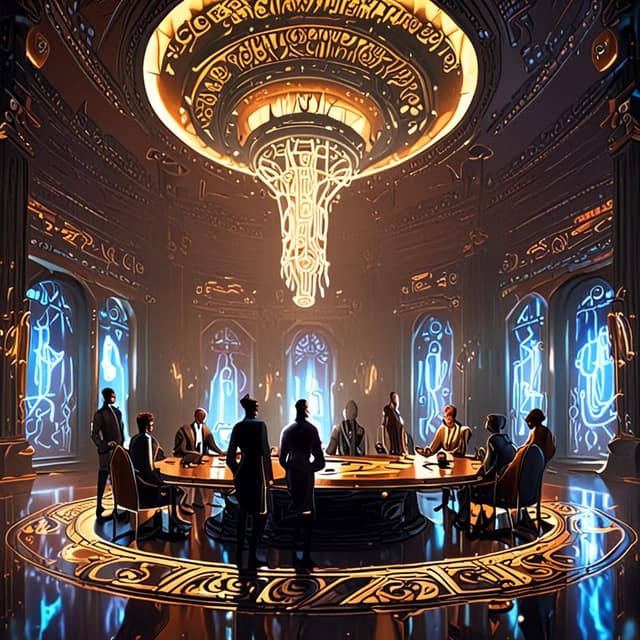
| Name | Confederation Council |
| Type | Governing and legislative institution |
| Powers | Executive • Legislative • Judicial |
| Composition | Appointed representatives from member world governments |
| Responsibilities | Military defense • Scientific research • Economic affairs |
| Governing body of | |
| Governance structure | Centralized, in contrast to the more decentralized Federation in the primary timeline |
The Confederation Council is the primary governing and legislative body of the United Galactic Confederation, holding significant executive, legislative, and judicial authority over the entire interstellar alliance. Unlike the more decentralized Federation Council, the Confederation Council plays a central role in the day-to-day governance and decision-making of the alliance.
The Confederation Council is composed of appointed representatives from the governments of each member world within the United Galactic Confederation. The number of Council seats per member world is proportional to their population and economic/military contribution to the Confederation.
For example, the founding members of Earth, Vulcan, and Andoria each hold multiple permanent seats, while smaller member worlds like Betazed or Tellar Prime may only have one or two representatives. The appointment of Council members is determined by the individual governments of each world, rather than through direct elections.
The Council is led by a Speaker of the Council, who serves as the presiding officer and chief administrator. This position rotates among the Council members on a regular basis.
The Confederation Council holds a wide range of executive, legislative, and judicial powers, making it the most powerful governing institution in the Confederation:
Executive Powers:
Legislative Powers:
Judicial Powers:
The Council's decisions are considered binding on all member worlds, in contrast to the more advisory role of the Federation Council. Member governments are legally obligated to implement and enforce Council policies.
The Confederation Council operates on a system of majority rule, with each representative holding one vote. Most decisions require a simple majority to pass, but measures related to military actions, territorial expansion, or the Confederation's governing charter require a two-thirds supermajority.
Council proceedings are highly formalized, with strict parliamentary procedures and a robust bureaucracy of civil servants to prepare legislation and enforce Council directives. The Speaker and Council leadership play a key role in setting the agenda and managing the flow of business.
While member worlds can petition the Council or attempt to sway its decisions, the centralized structure of the Confederation grants the Council a high degree of autonomy and the ability to override the objections of individual governments when necessary. This has at times led to tensions and even conflicts between the Council and disgruntled member worlds.
